Positive Reinforcement Dog Training: The Science of Rewards
How operant conditioning and well-timed rewards shape behavior, and why the AVSAB recommends reward-based methods for all dog training.

Watch a dog learn, and you are watching a prediction engine at work. Behaviors that pay off get repeated; behaviors that cost something quietly disappear. That single principle—behavior follows consequences—is the foundation of positive reinforcement training, and it explains why the modern standard looks less like correction and more like conversation.
Operant Conditioning, in Plain Language
Learning scientists call the framework operant conditioning: an animal operates on its environment, and the outcome of each action changes how likely that action becomes in the future. Add something the dog genuinely wants after a behavior—a treat, a game of tug, the chance to sniff an interesting hedge—and that behavior strengthens. That is positive reinforcement, and it is the mechanism behind every well-run training session.
The terminology trips people up constantly. "Positive" does not mean cheerful; it means something is added. Reinforcement means the behavior becomes more frequent over time. Punishment describes a consequence that reduces a behavior: positive punishment adds an aversive stimulus, while negative punishment removes access to something the animal values. Negative reinforcement is different again: removing an aversive stimulus strengthens behavior. All four combinations appear throughout the learning-theory literature, but they are not equivalent in practice, because consequences do more than change what a dog does. They change how a dog feels.
That emotional residue is the insight reward-based trainers keep returning to. A dog who is reinforced generously for walking politely is not merely complying; she is building an expectation that her person predicts good things. A dog who is yanked, shocked, or shouted at may learn to suppress the behavior, but he is also learning that his handler predicts discomfort. That distinction shapes far more than a training session.
Timing Is the Whole Game
Consequences only teach if the learner can connect them to the action that produced them. A treat delivered five seconds after a sit often lands on whatever the dog does next—sniffing the floor, wandering off, or jumping up—which may be the exact opposite of what you intended to reward. Effective training is therefore largely a matter of precise timing.
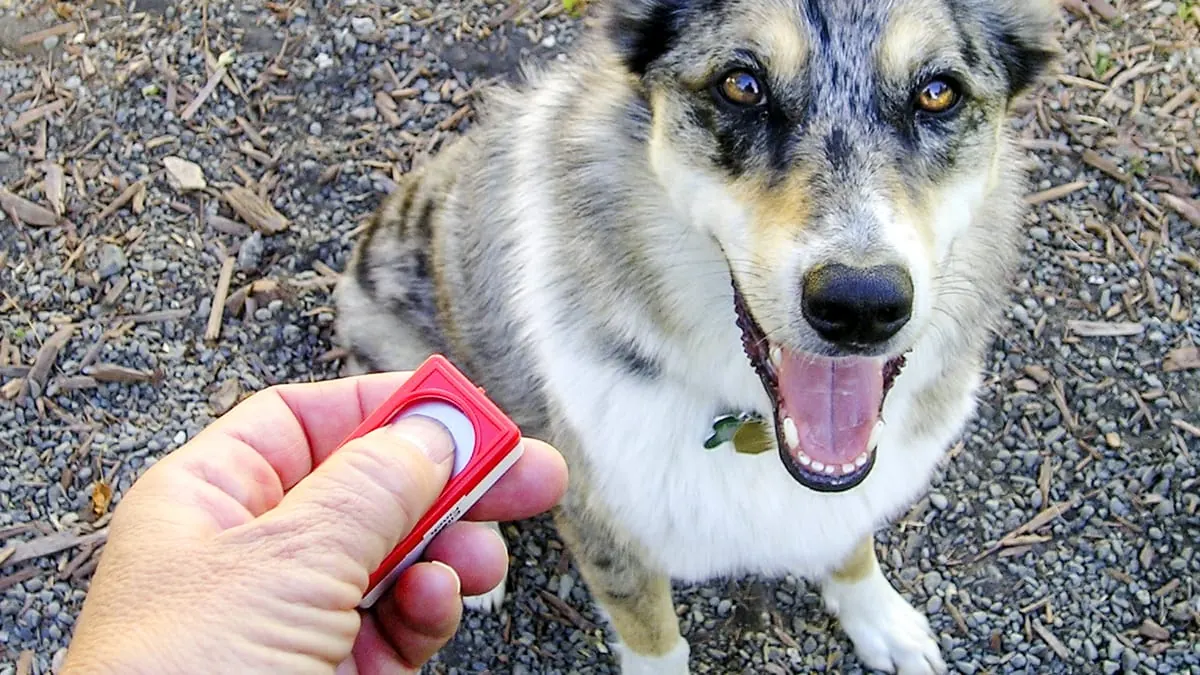
Trainers solve the timing problem with marker signals: a short, consistent sound such as a clicker, or a crisp verbal marker like "yes," that pinpoints the exact instant the desired behavior occurs and promises a reward is on the way. The marker bridges the gap between the moment and the treat, so the dog knows precisely which action earned the paycheck. [2]
Precision extends beyond the marker itself. Reward-based trainers capture behaviors the dog offers naturally, lure new positions with food, or shape complex actions by reinforcing small movements toward a goal. Just as important, they arrange the environment so the dog can succeed in the first place—closing blinds, restricting access to trash, and managing daily setups so unwanted behavior never gets rehearsed by accident.
What the Evidence Actually Shows
The scientific case was crystallized in 2021, when the American Veterinary Society of Animal Behavior published its position statement on humane dog training. The statement concludes that reward-based methods hold clear advantages for the learner's welfare, for training effectiveness, and for the dog-human relationship—and it recommends them as the standard for everything from basic manners to serious behavior problems. [1]
The wording is deliberately unambiguous. Because aversive methods, by the AVSAB's definition, rely on the application of force, pain, or emotional or physical discomfort, and because the group found no evidence that such methods are necessary or more effective in any context, it advises that aversives should not be used in training or in the treatment of behavior disorders.
That includes prong and shock collars, leash corrections, and intimidation—even for difficult cases such as aggression.
Welfare on the line
The welfare findings behind that position are stark. Dogs trained with aversive tools showed measurable stress signals during sessions—tense bodies, lowered posture, lip licking, yawning, panting, yelping—while dogs trained with rewards showed increased attentiveness to their owners.
Survey studies have also associated aversive training with longer-term problems, including aggression toward people and other dogs, and one widely cited study found that dogs trained with aversive methods were more pessimistic in judgment-bias tests than dogs trained with rewards.
Effectiveness research points the same direction. A large survey of British dog owners found obedience highest among dogs trained exclusively with rewards and lowest among those trained exclusively with punishment, and later work on electronic collars found no advantage over reward-based recall training. These studies have different designs and limitations; an association in a survey alone does not establish causation. AVSAB weighs the broader evidence when recommending reward-based methods.
None of this means boundaries disappear. Reward-based training still involves structure: reinforcing what you want, withholding rewards for what you don't, and arranging the environment so the right choice is the easy choice. What it rejects is the idea that fear is a necessary teaching tool—a claim the accumulated evidence does not support.
Finding Good Help
For everyday issues such as jumping, barking, or housetraining setbacks, the AVSAB notes that reinforcement plus environmental management is usually enough. More serious concerns—aggression, anxiety, and fear—call for a plan that may combine management, behavior modification, and in some cases medication prescribed by a veterinarian. Both tracks rest on the same foundation: teach the dog what to do rather than punishing what it did.
That guidance matters for anyone hiring help, because dog training remains largely unregulated and quick-fix marketing still sells dominance narratives. The position statement gives owners a practical filter: be wary of anyone whose toolkit includes prong or shock collars, alpha rolls, or claims that some stubborn dogs need force. Look instead for credentialed trainers fluent in reinforcement, and for complex cases, board-certified veterinary behaviorists.
Reward-based training is not permissive, and it is not wishful thinking. It is applied behavioral science delivered in a way that keeps the learner willing. The reward is not a bribe; it is information. And a dog who understands exactly what pays off—and trusts the person handing it over—is the one who keeps choosing you, cue after cue, year after year.
Sources and further reading
Editorially reviewed on . Sources support the topics noted below; this is not a veterinary review or individual medical advice.
- AVSAB: 2021 Humane Dog Training Position Statement — AVSAB position, welfare evidence and the scope of its recommendation.
- AKC: Mark and reward with a clicker — Marker signals and timing of rewards.
More in Training & Behavior
All Training & Behavior →Clicker Training Fundamentals: Markers, Shaping, First Steps
A practical introduction to clicker training: how marker signals work, what shaping really means, and how to run your first short sessions.
Cat Litter Box Problems: Causes and Humane Fixes That Work
A vet-first guide to litter box problems: box count, cleanliness, placement, and telling medical causes from behavioral ones.

Why Cats Scratch and How to Redirect the Behavior
Why cats need to scratch, how to choose and place appealing scratchers, and why behavior support and non-surgical alternatives matter.