Pet Food Calories: Convert kcal/kg, Cups and Cans Correctly
Four worked label calculations show how to convert food energy units, avoid a thousand-fold error and keep portions separate from calorie prescriptions.
One label lists 3,600 kcal/kg. Another says 90 kcal per can. Your feeding plan uses grams, while the package guide uses cups. Those numbers can describe the same food without being interchangeable. The task is to preserve the unit at every step, then apply an existing appropriate feeding plan.
Keep the energy unit attached
- Copy the calorie statement for the exact food and package.
- Convert kcal per kilogram to kcal per gram before multiplying by a gram portion.
- Add every food contribution and compare with an existing appropriate feeding plan.
The worked numbers teach arithmetic and do not prescribe an intake.
Write the unit beside every number
AAFCO describes calorie statements in kilocalories per kilogram of food as fed and per familiar unit, such as a cup or can. The food calorie and kilocalorie refer to the same energy unit in this context. “As fed” includes the product's moisture; energy density alone does not establish nutritional quality or an individual's needs. [1]
From kilograms to grams: divide once by 1,000
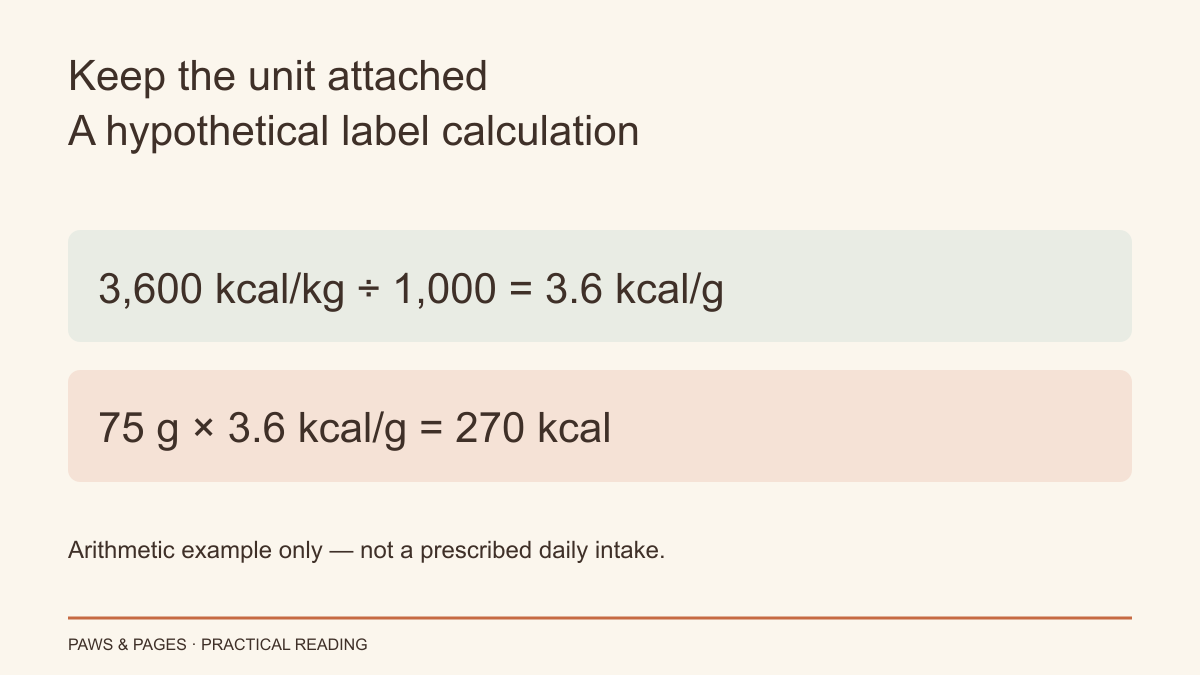
In this hypothetical example, 3,600 kcal/kg divided by 1,000 equals 3.6 kcal/g. A measured 75 g portion therefore supplies 75 × 3.6 = 270 kcal. Multiplying 75 by 3,600 without converting the kilogram is the thousand-fold error to catch. Write the intermediate 3.6 kcal/g value before calculating the portion.
If an agreed complete-food allocation were 270 kcal for that product, the reverse calculation would be 270 ÷ 3.6 = 75 g. This is arithmetic using a supplied allocation, not a recommended daily intake. Treats, other foods and any reserved training ration still belong in the overall feeding plan.
Cups and cans need the correct reference size
Suppose that same label also says 360 kcal per cup. Half of that stated cup supplies 180 kcal. Its implied weight is 360 ÷ 3.6 = 100 g per stated cup. Do not transfer that gram weight to another kibble or assume any drinking mug has the manufacturer's cup measure. Ask the manufacturer when the reference is unclear.
For a different hypothetical product at 90 kcal per 85 g can, two whole cans supply 180 kcal. Half a can by evenly divided food weight supplies approximately 45 kcal. A larger can of the same brand may contain a different amount or formulation: check the exact package rather than multiplying a familiar brand number.
Make mixed feeding add up
A teaching example of one 90 kcal can plus 50 g of the 3.6 kcal/g dry food gives 90 + 180 = 270 kcal. That does not mean this mix is nutritionally suitable. It shows why “one can plus half the normal dry portion” needs actual label values and an agreed total.
Save the exact food name and units with your calculation. Use the Feeding Planner after establishing the daily gram portion and calorie allowance; it divides a supplied ration but does not perform a veterinary nutritional assessment. Recheck package values when the product changes, and discuss suitability rather than choosing solely on the smallest calorie number.
Sources and further reading
Editorial source notes dated . These source notes support the topics listed below; their date is separate from the article update shown above. This is not a veterinary review or individual medical advice.
Sources checked November 6, 2026; publication dates of sources may be older. Worksheets and hypothetical examples are editorial teaching aids, not individual clinical, legal or insurance advice.
- AAFCO: Calories — Calorie units, as-fed comparisons and limits of energy density as a selection criterion.
More in Nutrition
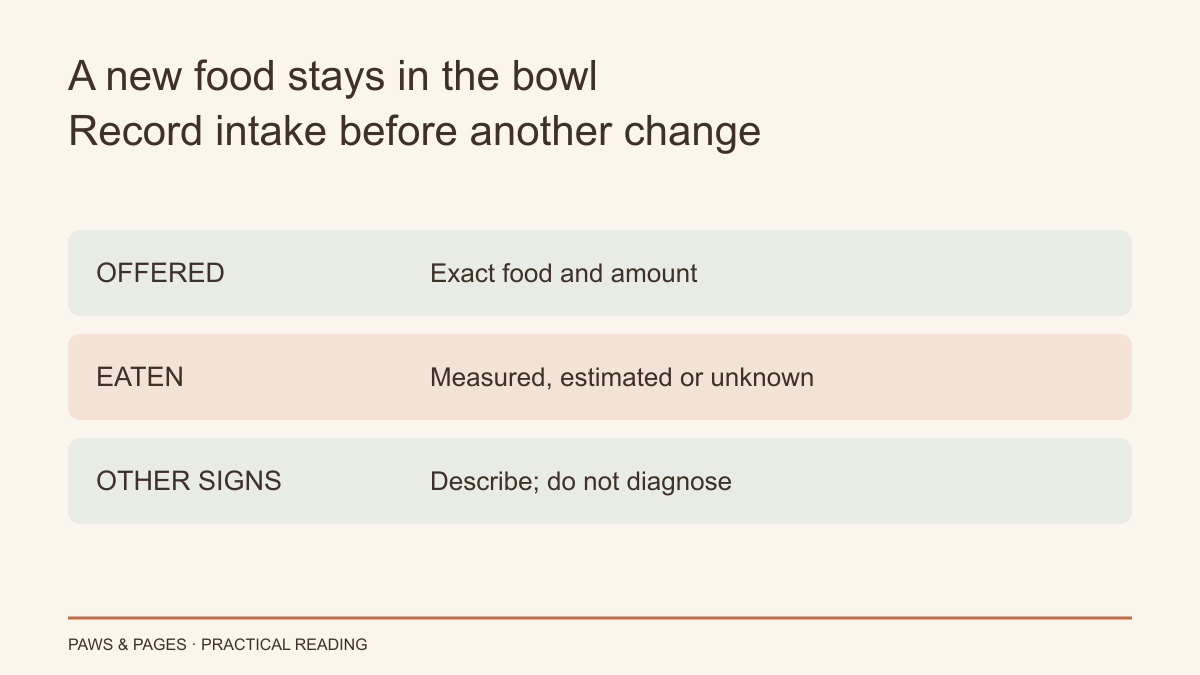
All Nutrition →New Food, Uneaten Bowl: What to Record Before Another Change
Separate a food-transition problem from reduced intake. Use a meal record and timely veterinary advice rather than repeated swaps or a hunger standoff.
How Pet Food Recalls Work and How to Check Your Bag
From FDA oversight to lot codes on the label, a plain-language guide to pet food recalls and the steps to take if your bag is affected.
Cat Hydration: Wet vs. Dry Food and Your Cat's Water Needs
Why cats have a low thirst drive, how wet and dry food differ in water content, and what hydration means for feline urinary and kidney health.