Same Breed, Different Dog: A Household-Fit Meeting Worksheet
Turn a dog meeting into useful observations: separate known history, what you see today and unanswered questions about your everyday household.
You have read the breed profile and found a dog you like. The remaining question is narrower: can this individual live comfortably in your actual household? A pleasant meeting is useful, but it cannot reproduce your working day, visitors, stairs or other animals. This worksheet organizes the uncertainties without pretending to be a temperament test.
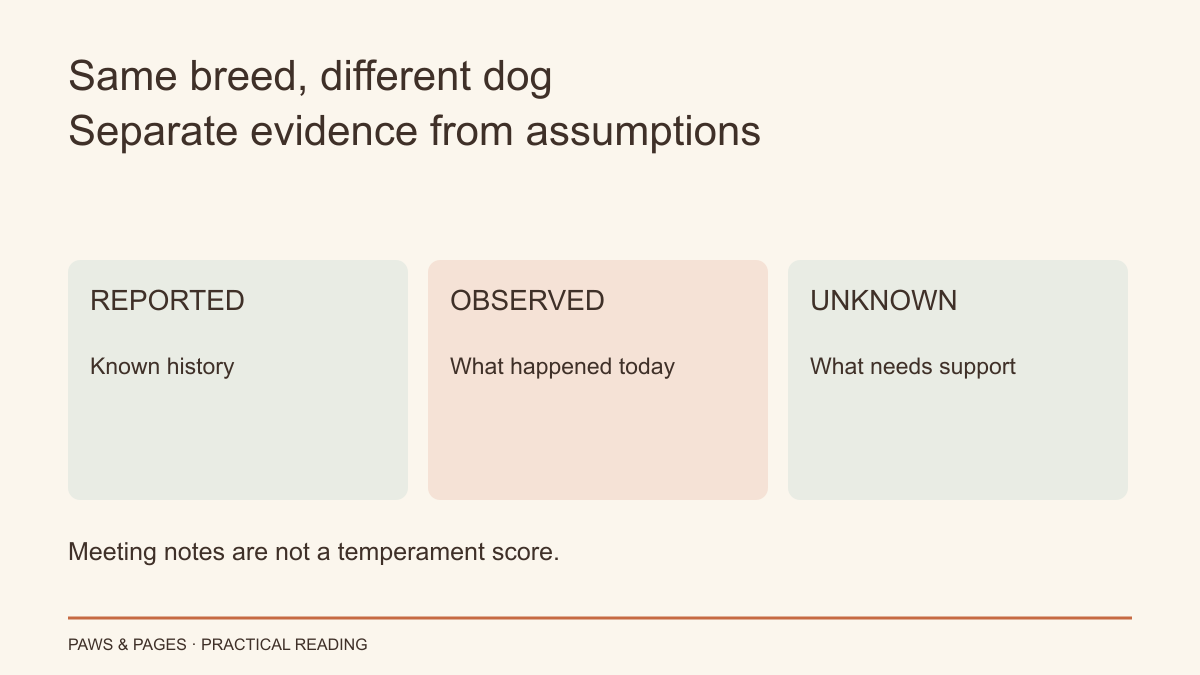
Take three columns to the meeting
- Write the constraints of an ordinary weekday before meeting the dog.
- Separate reported history, what you observe today and what remains unknown.
- Agree on support, introductions and practical next steps before committing.
Do not provoke distress or remove food to test an animal.
Start with the weekday you really have
Write down departure and return times, who provides exercise, where the dog would rest and which situations are difficult to change. Include noisy neighbors, a resident cat or an adult who cannot safely handle strong pulling. Avoid a list built around an unusually free weekend. The question is whether a feasible arrangement exists on an ordinary day.
Best Friends Animal Society recommends considering the individual dog's personality, needs and your lifestyle, and learning about body language before a meeting. Use breed information as background rather than a promise about one dog's behavior. [1]
Keep three kinds of information separate
Make headings for “reported history,” “observed today” and “still unknown.” A foster carer's description of resting during a normal household absence belongs in the first column. Watching the dog settle during your visit belongs in the second. Whether it can stay alone during your specific shift remains a question until you have relevant evidence and a support plan.
Record context beside observations. “Looked toward another dog across the courtyard, then returned to sniffing” is more useful than “good with dogs.” Note who was present, the distance and whether a handler helped. Do not create an encounter, remove food or expose the dog to distress simply to fill the sheet.
Ask for examples, not reassuring adjectives
Replace “Is this dog easy?” with questions that have observable answers: What happens when a visitor arrives? What alone-time history is known? How does handling usually work? Has the dog lived with the species or age groups in our home? What medical or behavior support is already in place?
A hypothetical family might learn that a calm meeting took place after a long walk, while its own mornings allow little exercise. That difference does not make the dog unsuitable by definition. It identifies a planning question: who can provide an appropriate routine, and what assistance is available if settling proves difficult?
Leave with a plan for uncertainty
Ask about supported introductions, follow-up and the organization's placement or return arrangements. Clarify responsibilities before committing. “We do not know yet” is useful information when paired with realistic management; it should not be converted into a guarantee to make a decision feel easier.
Save your practical questions in My Pet Desk and use New Pet Path to prepare the home. The goal is a supported decision about one animal, not a ranking of breeds or a pass/fail score from a short visit.
Sources and further reading
Editorial source notes dated . These source notes support the topics listed below; their date is separate from the article update shown above. This is not a veterinary review or individual medical advice.
Sources checked November 6, 2026; publication dates of sources may be older. Worksheets and hypothetical examples are editorial teaching aids, not individual clinical, legal or insurance advice.
- Best Friends Animal Society: Choosing a dog — Individual personality, household fit and preparation before a meeting.
More in Breeds
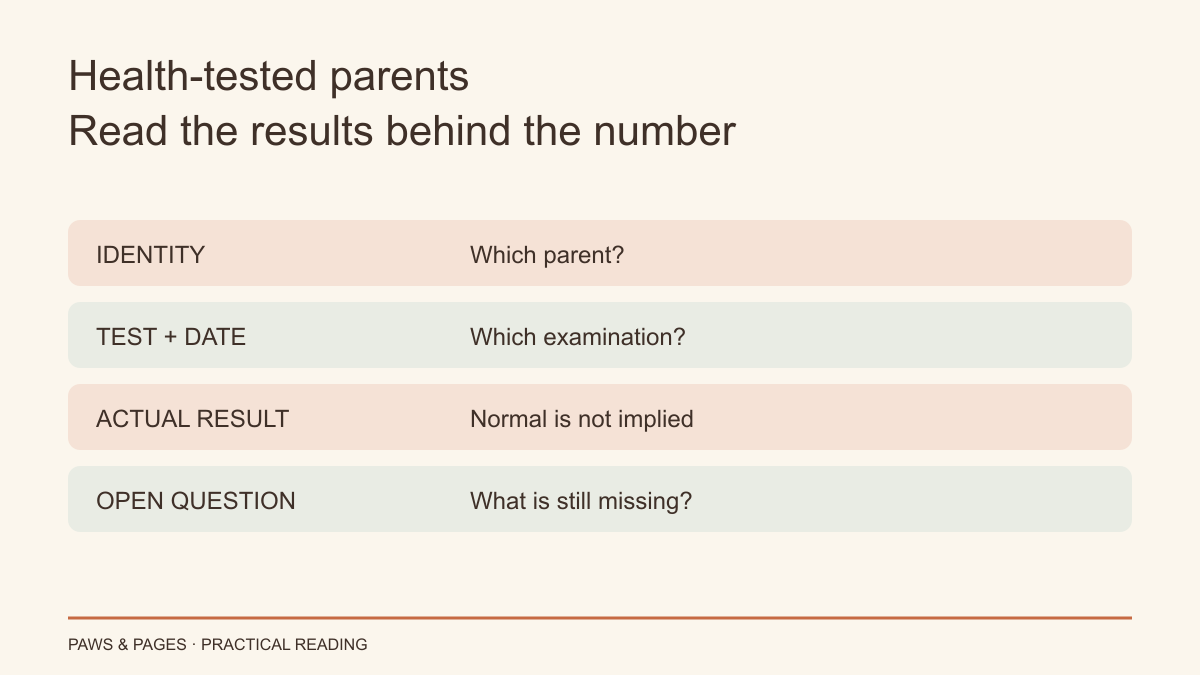
All Breeds →Health-Tested Parents: Which Records Should You Actually Check?
A practical record-checking workflow for health-tested breeding dogs: identity, tests, results and dates, without mistaking certification for a guarantee.
Ragdoll Cat Breed Profile: Size, Blue Eyes and Temperament
Ragdoll cat facts: size, blue eyes, colorpoint coat, laid-back temperament, grooming and health notes, and who this gentle breed suits.

Mixed-Breed Dogs: What Shelters and Genetics Tell Us
An evidence-based look at mixed-breed dogs: longevity and genetic studies, hybrid vigor, size unpredictability, and the shelter adoption picture.