Two Pet Insurance Quotes: Compare the Same Bill Before Buying
Compare policy documents using identical hypothetical bills, eligibility assumptions and payment timing, instead of choosing solely by premium or percentage.
Two quotations both advertise 80% reimbursement. One costs less per month, so the choice seems easy. Yet the percentage may apply to different eligible costs, after different deductibles and subject to different limits. Before deciding, compare what each written policy would do with the same clearly stated scenario.
Ask both insurers the same questions
- Match coverage type, document version, deductible basis and relevant limits.
- Request written results for the same bill with explicit eligibility assumptions.
- Test a second claim and ask when the owner must pay the clinic.
Illustrative calculations are not coverage confirmations, quotes or purchase recommendations.
Make a policy comparison before a price comparison
NAIC explains that pet insurance varies in coverage, exclusions, deductibles, payment limits and reimbursement methods. It also distinguishes accident-only, accident-and-illness and wellness offerings. Two premiums do not describe equivalent protection merely because the percentages look alike. Read the sample wording for your jurisdiction and ask the insurer about uncertain terms. [1]
Make columns for the document version, coverage type, deductible basis, reimbursement basis, relevant exclusions, waiting periods, benefit limit and payment process. Mark an unanswered question as unknown rather than selecting whichever interpretation produces the larger payment.
Run one eligible-bill example, then change the assumptions
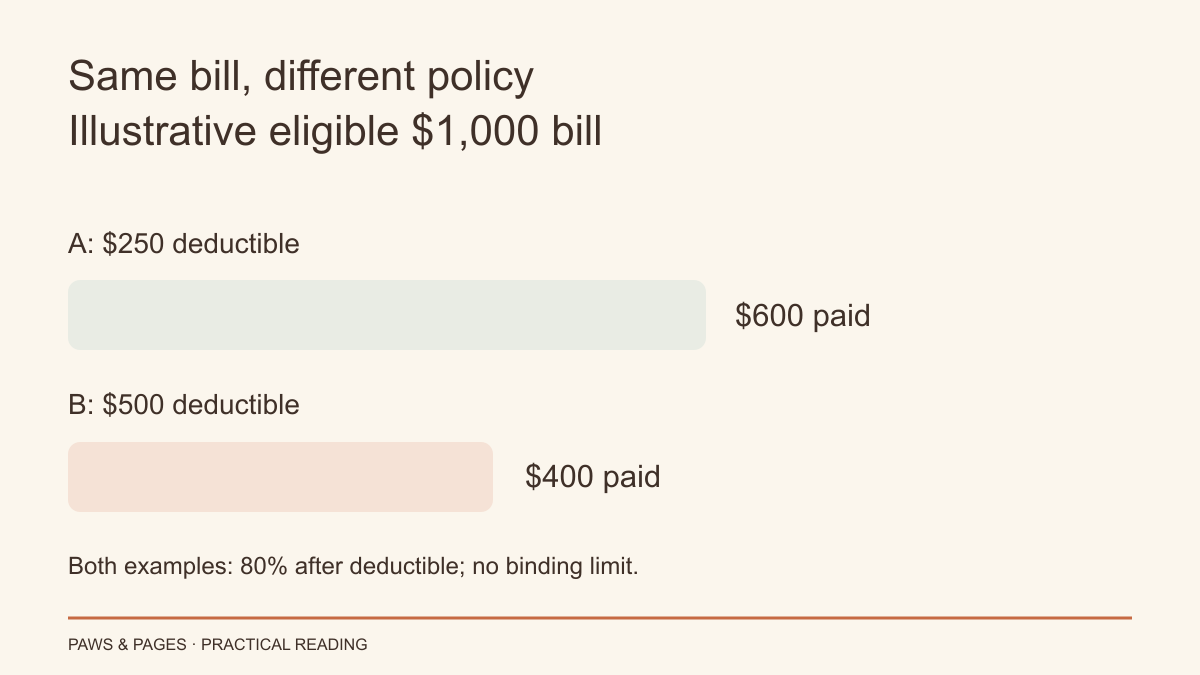
In a deliberately simplified example, Policy A pays 80% of eligible charges after a remaining $250 deductible. A fully eligible $1,000 bill gives ($1,000 − $250) × 0.80 = $600 paid, leaving $400 of that bill to the owner. Policy B has the same sequence and percentage but a $500 remaining deductible: payment is $400, leaving $600.
That difference does not prove A is better. The premiums, limits and eligible charges may differ. Ask both insurers to calculate the same scenario using their actual wording, including any applicable fees or taxes. Do not silently treat a fixed benefit schedule as reimbursement of a percentage of every clinic charge.
A second claim reveals deductible structure
Suppose the first eligible claim used up an annual deductible. A later eligible claim in that policy year might have no remaining annual deductible. A per-condition arrangement could work differently when the next problem is unrelated. Ask the insurer to show the second scenario, identify the policy year and state which deductible remains.
Then test a scenario with a possible exclusion, earlier symptom or exhausted limit. The answer may be a reduced payment or no payment; it cannot be calculated honestly without the eligibility decision. Do not invent a prognosis or misdescribe medical history to obtain a favorable estimate.
Ask when the money changes hands
A policy that reimburses later may still require you to pay the clinic first. Ask about records, submission deadlines and direct-payment arrangements, if offered. Consider accessible funds as well as the eventual out-of-pocket amount. A hypothetical reimbursement calculation is not a coverage confirmation or a recommendation to buy a particular policy.
Keep the insurer's written responses alongside the quotes, and check renewal or replacement terms before cancelling existing coverage. For the broader market context, read what enrollment and premium statistics measure. This worksheet's distinct purpose is to reveal differences between two contracts using the same questions and assumptions.
Sources and further reading
Editorial source notes dated . These source notes support the topics listed below; their date is separate from the article update shown above. This is not a veterinary review or individual medical advice.
Sources checked November 6, 2026; publication dates of sources may be older. Worksheets and hypothetical examples are editorial teaching aids, not individual clinical, legal or insurance advice.
- NAIC: Pet insurance — Coverage, deductibles, limits and different reimbursement structures; examples are not quotes.
More in Industry News
All Industry News →Pet Food Subscriptions: Calculate the Cost After the First Box
Compare pet-food subscriptions using renewal prices, usable food, delivery timing and cancellation terms, with an original three-delivery worked example.
Flying With Pets: Airline Rules and What US Regulators Require
US airline pet rules turn on DOT incident reports, cabin-versus-cargo distinctions and health certificates — and on where federal mandates end.

Pet Insurance Market Growth: What NAPHIA's Data Shows
NAPHIA reports 7.6 million insured North American pets at the end of 2025. What premium growth measures, and what buyers must check in a policy.